Iran conflict, fertilizer supply chains, food security: The ‘Banio’ project in Gabon combines significant resources, an Atlantic location, ongoing DFS, and a new Phase 3 drilling program.

Advertisement – This article is published on behalf of Millennial Potash Corp.! · Paid Relationship: SRC swiss resource capital AG maintains a paid IR advisory agreement with Millennial Potash · Producer: JS Research GmbH, Olsberg · Author: Jörg Schulte (Managing Director, JS Research GmbH) · Compensation provided by SRC · First published: May 14, 2026, 9:38 a.m. Europe/Berlin ·
+++ The Silent Bottleneck in Agriculture +++
Dear Readers,
Hormus is not just an oil issue. Energy, LNG, ammonia, and fertilizer supply chains are all interconnected. This connection is important for investors because fertilizers are not just an agricultural issue, but a cornerstone of global supply security.
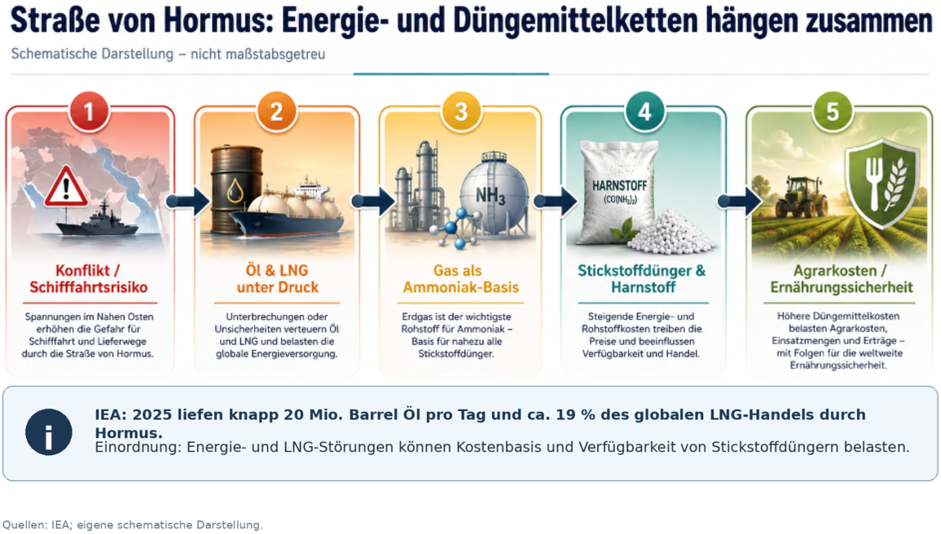
The fertilizer market is more vulnerable than many investors realize. Geopolitical conflicts, disrupted trade routes, higher energy costs, and delayed shipments don’t just affect oil and gas. They can also impact fields, yields, and food prices. The Strait of Hormuz highlights this vulnerability. According to the International Energy Agency, nearly 20 million barrels of oil per day and about 19% of global LNG trade passed through this chokepoint in 2025. Nitrogen fertilizers and urea, in particular, are heavily dependent on gas and ammonia. If energy flows stall or become more expensive, this can strain the cost base and availability of key fertilizers.
Potash is at the center of this debate for another reason: Potassium is an essential plant nutrient and cannot simply be replaced by more nitrogen or phosphate. Anyone seeking to make agriculture and harvests more resilient must therefore also keep an eye on the supply of potash.
A concentrated market — and that is precisely what makes this so critical!
The potash market is highly concentrated. According to USGS data, a large portion of global mine production comes from just a few countries, primarily Canada, Russia, China, and Belarus.
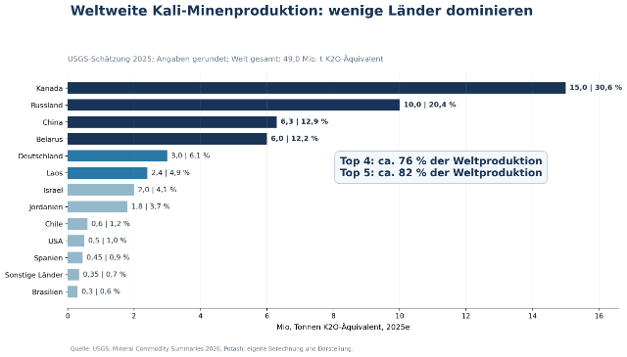
At the same time, major agricultural nations are net importers. Agricultural commodities are thus becoming strategic raw materials.
The key question is therefore not just: Where is potash found? But rather: Where can potash be developed cost-effectively, logistically sensibly, and with access to key markets? It is precisely at this intersection that the ‘Banio’ project by Millennial Potash Corp. (WKN: A3DXEK) becomes interesting to market observers.
Millennial Potash: ‘Banio’ fits into the new supply security logic!

Millennial Potash Corp. (WKN: A3DXEK) is developing ‘Banio,’ a potash project in Gabon on the Atlantic coast of West Africa. From the perspective of the current market debate, this location is a key factor: proximity to the coast, export logistics, and potential access to markets such as Brazil, the U.S., Africa, and Asia can play an important role in the potash market.
The company data published to date already indicates a considerable scale. Millennial reports a “measured” mineral resource for “Banio” of 648.2 million tons at 15.7% KCl, an “indicated” mineral resource of 1.8 billion tons with 15.6% KCl, and an “inferred” mineral resource of 3.56 billion tons with 15.6% KCl. Important: Mineral resources are not mineral reserves and do not indicate assured economic recoverability.
The 2024 PEA also provided strong, though assumption-based, project metrics: post-tax NPV10 of $1.07 billion, post-tax ‘IRR’ of 32.6%, initial capital costs of $480 million, and OPEX of approximately $61 per tonne of gMOP.
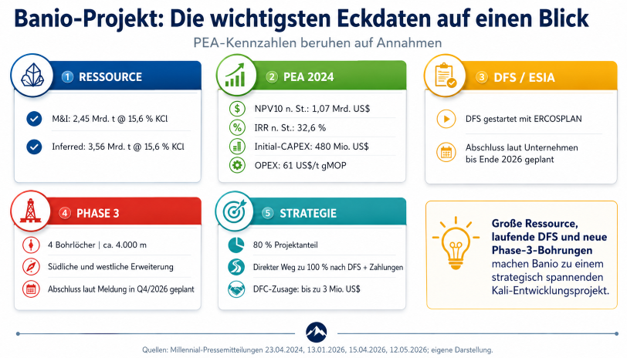
However, a "PEA" is an early economic assessment and does not guarantee future profitability.
Current catalyst: ‘Phase 3’ is underway!
The latest company announcement provides the current catalyst. Millennial Potash (WKN: A3DXEK) has launched the ‘Phase 3’ drilling program at ‘Banio’. Four potash-specific drill holes totaling approximately 4,000 m are planned to test potential extensions of the known potash resources to the south and west of the existing mineralization.
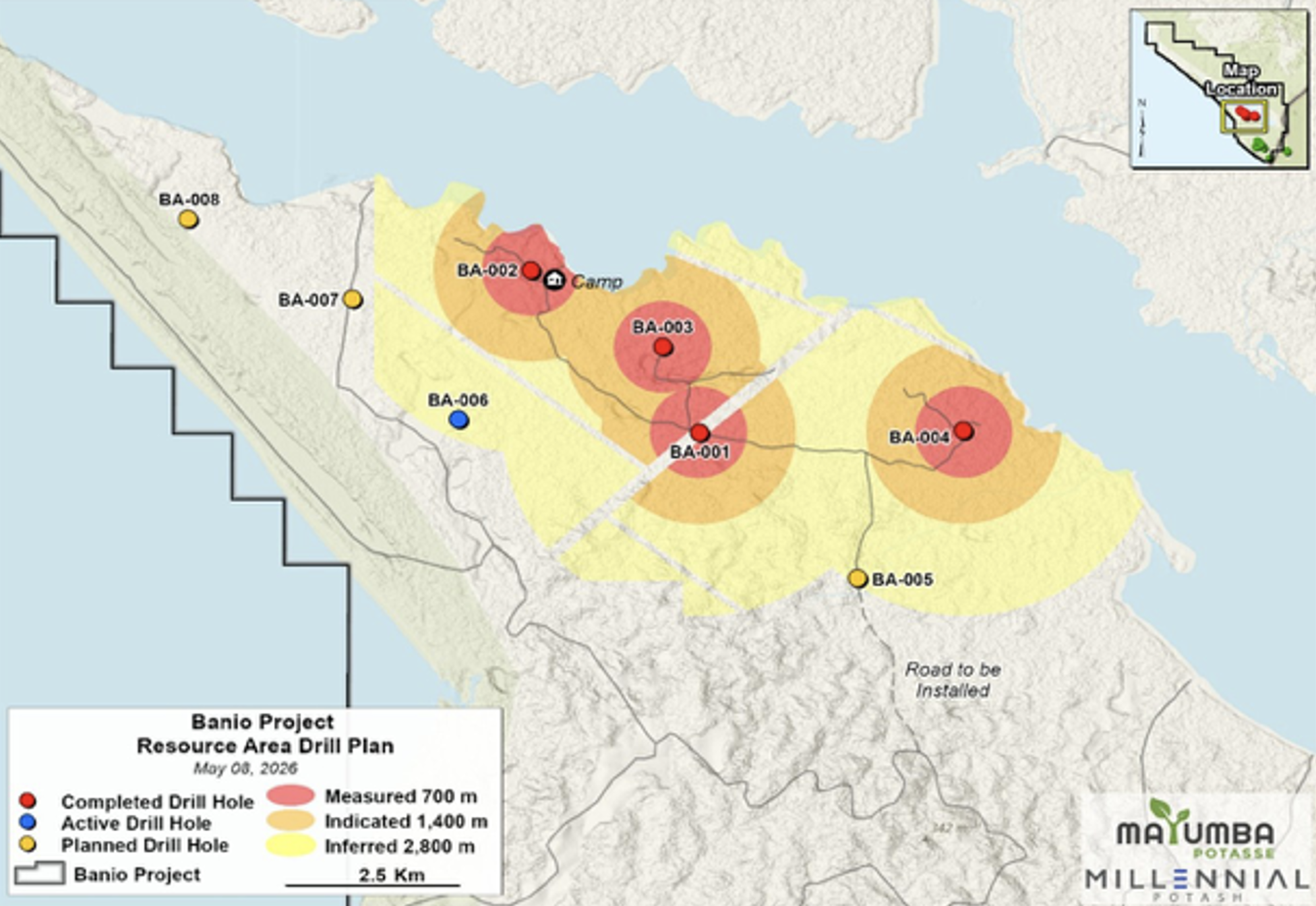
Source: Millennial Potash
Of particular interest is the location of two planned drill holes on the newly acquired ‘Haute-Banio’ exploration license. According to the company, this area encompasses the coastal portion of the project and is closer to planned port and infrastructure. This aligns with the project logic of a potash project, where access to market is just as crucial as resources and geology.
‘DFS,’ ‘DFC,’ and an 80% stake: ‘Banio’ is gradually becoming ready for development!
In January 2026, Millennial launched the definitive feasibility study for ‘Banio’ and commissioned ERCOSPLAN as the potash specialist. According to the company, the so-called ‘DFS’ is scheduled to be completed by the end of 2026. Additionally, the U.S. International Development Finance Corporation has committed up to $3 million to support the feasibility study.
In April 2026, Millennial Potash (WKN: A3DXEK) also reported that its stake in the project company Equatorial Potash had increased to 80%. This gradually strengthens the project’s narrative: a large resource, an ongoing DFS, a strategic commodity, a coastal location, and a new drilling program with potential for resource expansion — though development risks remain.
For more background on the fertilizer story and the development of "Banio," see the interview with Farhad Abasov in German. The link takes you directly to the interview and can be used editorially as a reference for further reading.
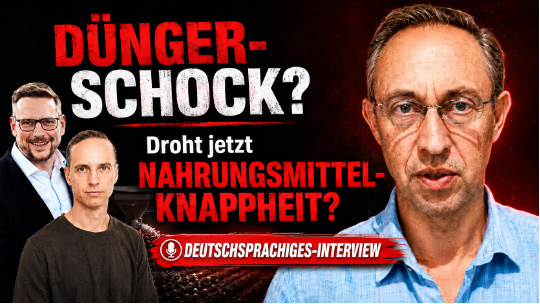
Interview link: https://www.youtube.com/watch?v=N3ttNz3Avvs
Conclusion: Truly no ordinary potash story!
The Iran conflict highlights just how closely energy, logistics, fertilizers, and food security are intertwined. Potash is particularly in the spotlight because it is essential for plants and the market is dominated by just a few supplier countries.
Millennial Potash (WKN: A3DXEK) positions ‘Banio’ in a market environment where supply security is receiving greater attention. The company is not yet a producer, and the path to the mine remains fraught with typical development risks. Nevertheless, the combination of a large resource, an Atlantic location, a positive PEA, an ongoing DFS, DFC support, an 80% project stake, and a Phase 3 drilling program is strategically interesting from today’s perspective.
Nevertheless, Millennial Potash (WKN: A3DXEK) remains a speculative commodity stock whose future development depends largely on drilling results, updated resources, the DFS, the ESIA, financing, permits, commodity prices, infrastructure, and general market conditions, all of which in turn may present potential for revaluation.
Best regards
Yours
Jörg Schulte
Sources and Methodology
1. Millennial Potash Corp.: Company announcement “Initiation of Phase 3 Drill Program at its Banio Potash Project,” May 12, 2026, provided by the user.
2. Millennial Potash Corp.: Press release “Initiates Definitive Feasibility Study with US DFC Funding at its Banio Potash Project, Gabon,” January 13, 2026.
3. Millennial Potash Corp.: Press release “Completes Milestone Payment and Increases Ownership ... to 80%,” April 15, 2026.
4. Millennial Potash Corp.: Press release “Completes Positive PEA with After-Tax NPV(10) of $1.07B and IRR of 32.6%,” April 23, 2024.
5. U.S. Geological Survey: Mineral Commodity Summaries 2026, Potash chapter.
6. International Energy Agency: Strait of Hormuz - Oil Security and Emergency Response; Ammonia Technology Roadmap.
7. YouTube interview with Farhad Abasov / Millennial Potash; link in the article.
Source of intro image: stock.adobe.com
Methodology: The article distinguishes between verified company data, macroeconomic analysis, and forward-looking assessments. PEA metrics, DFS timelines, drilling targets, and potential resource expansions are not a guarantee of future results.
Legal Notice / Advertisement / Marketing Communication
This article is an advertisement and a marketing communication regarding Millennial Potash Corp. The article was created and distributed on behalf of Millennial Potash Corp. According to available information, there is a paid investor relations/marketing relationship between Millennial Potash Corp. and SRC swiss resource capital AG. JS Research GmbH was commissioned by SRC swiss resource capital AG to prepare and edit this article and was compensated for this work. The producer is JS Research GmbH, Olsberg; the author is Jörg Schulte, Managing Director of JS Research GmbH.
This article does not constitute independent financial analysis, investment advice, or an individual recommendation to buy, hold, or sell securities. The article does not take into account the personal investment objectives, financial circumstances, knowledge, experience, or risk tolerance of individual investors. Investors should conduct their own research and, if necessary, seek expert advice before making any investment decision.
Millennial Potash Corp. shares are speculative securities. Commodity, exploration, and development companies are subject to significant risks. These include, in particular, exploration, resource, study, permitting, financing, construction, operational, commodity price, exchange rate, market, liquidity , country, legal, environmental, and political risks. There is a risk of significant losses, up to and including total loss.
Based on the information provided, Millennial Potash Corp. is a development company and not yet a potash producer. Mineral resources are not mineral reserves and do not indicate assured economic viability. PEA figures are based on assumptions and are no guarantee of future profitability. Technical information regarding Millennial Potash Corp. and the ‘Banio’ project should be read in the context of the respective company announcements, technical reports, and Canadian disclosure standards, particularly NI 43-101.
This article contains forward-looking statements and assessments regarding commodity markets, geopolitical risks, fertilizer supply chains, the ‘Banio’ project, potential resource expansions, drilling programs, DFS, ESIA, financing, permits, construction, production, costs, and economic parameters. Such statements are based on assumptions, expectations, and currently available information. Actual results may differ materially. There is no obligation to update this article unless required by law.
The information used is based on company announcements from Millennial Potash Corp., publicly available market data, government/institutional sources, and our own editorial assessments. Despite careful preparation, no guarantee is given as to the accuracy, completeness, timeliness, or future validity of the information.
To the extent that this article could be classified as an investment recommendation or investment strategy recommendation within the meaning of Art. 20 of the Market Abuse Regulation, Delegated Regulation (EU) 2016/958, and/or Sections 85 and 86 of the German Securities Trading Act (WpHG), the disclosures presented regarding interests, sources, methodology, authors, distributors, date, and time apply. Whether a notification pursuant to Section 86 of the German Securities Trading Act (WpHG) is required or has been made must be conclusively verified by the responsible publishing entity. A statement regarding a BaFin notification may only be made if such notification has actually been made.
This article is not a securities prospectus, a key information document, or a public offering of securities in Germany, Canada, the United States, or any other jurisdiction. The publication has not been reviewed, endorsed, or approved by BaFin, the British Columbia Securities Commission, the TSX Venture Exchange, or any other regulatory authority.
Conflicts of Interest / Holdings: The paid relationship between Millennial Potash Corp., SRC swiss resource capital AG, and JS Research GmbH is disclosed at . Any equity positions, options, warrants, or other financial instruments held by JS Research GmbH, the author, SRC swiss resource capital AG, affiliated persons, or clients must be disclosed in accordance with applicable regulations, provided such interests exist.
Limitation of Liability: Liability for direct or indirect damages, consequential damages, financial losses, or lost profits arising from the use or non-use of this article is excluded to the extent permitted by law.
Advertisement – This article is published on behalf of Millennial Potash Corp.! · Paid Relationship: SRC swiss resource capital AG maintains a paid IR advisory agreement with Millennial Potash · Producer: JS Research GmbH, Olsberg · Author: Jörg Schulte (Managing Director, JS Research GmbH) · Compensation provided by SRC · First published: May 14, 2026, 9:38 a.m. Europe/Berlin ·
+++ The Silent Bottleneck in Agriculture +++
Dear Readers,
Hormus is not just an oil issue. Energy, LNG, ammonia, and fertilizer supply chains are all interconnected. This connection is important for investors because fertilizers are not just an agricultural issue, but a cornerstone of global supply security.
The fertilizer market is more vulnerable than many investors realize. Geopolitical conflicts, disrupted trade routes, higher energy costs, and delayed shipments don’t just affect oil and gas. They can also impact fields, yields, and food prices. The Strait of Hormuz highlights this vulnerability. According to the International Energy Agency, nearly 20 million barrels of oil per day and about 19% of global LNG trade passed through this chokepoint in 2025. Nitrogen fertilizers and urea, in particular, are heavily dependent on gas and ammonia. If energy flows stall or become more expensive, this can strain the cost base and availability of key fertilizers.
Potash is at the center of this debate for another reason: Potassium is an essential plant nutrient and cannot simply be replaced by more nitrogen or phosphate. Anyone seeking to make agriculture and harvests more resilient must therefore also keep an eye on the supply of potash.
A concentrated market — and that is precisely what makes this so critical!
The potash market is highly concentrated. According to USGS data, a large portion of global mine production comes from just a few countries, primarily Canada, Russia, China, and Belarus.
At the same time, major agricultural nations are net importers. Agricultural commodities are thus becoming strategic raw materials.
The key question is therefore not just: Where is potash found? But rather: Where can potash be developed cost-effectively, logistically sensibly, and with access to key markets? It is precisely at this intersection that the ‘Banio’ project by Millennial Potash Corp. (WKN: A3DXEK) becomes interesting to market observers.
Millennial Potash: ‘Banio’ fits into the new supply security logic!
Millennial Potash Corp. (WKN: A3DXEK) is developing ‘Banio,’ a potash project in Gabon on the Atlantic coast of West Africa. From the perspective of the current market debate, this location is a key factor: proximity to the coast, export logistics, and potential access to markets such as Brazil, the U.S., Africa, and Asia can play an important role in the potash market.
The company data published to date already indicates a considerable scale. Millennial reports a “measured” mineral resource for “Banio” of 648.2 million tons at 15.7% KCl, an “indicated” mineral resource of 1.8 billion tons with 15.6% KCl, and an “inferred” mineral resource of 3.56 billion tons with 15.6% KCl. Important: Mineral resources are not mineral reserves and do not indicate assured economic recoverability.
The 2024 PEA also provided strong, though assumption-based, project metrics: post-tax NPV10 of $1.07 billion, post-tax ‘IRR’ of 32.6%, initial capital costs of $480 million, and OPEX of approximately $61 per tonne of gMOP.
However, a "PEA" is an early economic assessment and does not guarantee future profitability.
Current catalyst: ‘Phase 3’ is underway!
The latest company announcement provides the current catalyst. Millennial Potash (WKN: A3DXEK) has launched the ‘Phase 3’ drilling program at ‘Banio’. Four potash-specific drill holes totaling approximately 4,000 m are planned to test potential extensions of the known potash resources to the south and west of the existing mineralization.
Source: Millennial Potash
Of particular interest is the location of two planned drill holes on the newly acquired ‘Haute-Banio’ exploration license. According to the company, this area encompasses the coastal portion of the project and is closer to planned port and infrastructure. This aligns with the project logic of a potash project, where access to market is just as crucial as resources and geology.
‘DFS,’ ‘DFC,’ and an 80% stake: ‘Banio’ is gradually becoming ready for development!
In January 2026, Millennial launched the definitive feasibility study for ‘Banio’ and commissioned ERCOSPLAN as the potash specialist. According to the company, the so-called ‘DFS’ is scheduled to be completed by the end of 2026. Additionally, the U.S. International Development Finance Corporation has committed up to $3 million to support the feasibility study.
In April 2026, Millennial Potash (WKN: A3DXEK) also reported that its stake in the project company Equatorial Potash had increased to 80%. This gradually strengthens the project’s narrative: a large resource, an ongoing DFS, a strategic commodity, a coastal location, and a new drilling program with potential for resource expansion — though development risks remain.
For more background on the fertilizer story and the development of "Banio," see the interview with Farhad Abasov in German. The link takes you directly to the interview and can be used editorially as a reference for further reading.
Interview link: https://www.youtube.com/watch?v=N3ttNz3Avvs
Conclusion: Truly no ordinary potash story!
The Iran conflict highlights just how closely energy, logistics, fertilizers, and food security are intertwined. Potash is particularly in the spotlight because it is essential for plants and the market is dominated by just a few supplier countries.
Millennial Potash (WKN: A3DXEK) positions ‘Banio’ in a market environment where supply security is receiving greater attention. The company is not yet a producer, and the path to the mine remains fraught with typical development risks. Nevertheless, the combination of a large resource, an Atlantic location, a positive PEA, an ongoing DFS, DFC support, an 80% project stake, and a Phase 3 drilling program is strategically interesting from today’s perspective.
Nevertheless, Millennial Potash (WKN: A3DXEK) remains a speculative commodity stock whose future development depends largely on drilling results, updated resources, the DFS, the ESIA, financing, permits, commodity prices, infrastructure, and general market conditions, all of which in turn may present potential for revaluation.
Best regards
Yours
Jörg Schulte
Sources and Methodology
1. Millennial Potash Corp.: Company announcement “Initiation of Phase 3 Drill Program at its Banio Potash Project,” May 12, 2026, provided by the user.
2. Millennial Potash Corp.: Press release “Initiates Definitive Feasibility Study with US DFC Funding at its Banio Potash Project, Gabon,” January 13, 2026.
3. Millennial Potash Corp.: Press release “Completes Milestone Payment and Increases Ownership ... to 80%,” April 15, 2026.
4. Millennial Potash Corp.: Press release “Completes Positive PEA with After-Tax NPV(10) of $1.07B and IRR of 32.6%,” April 23, 2024.
5. U.S. Geological Survey: Mineral Commodity Summaries 2026, Potash chapter.
6. International Energy Agency: Strait of Hormuz - Oil Security and Emergency Response; Ammonia Technology Roadmap.
7. YouTube interview with Farhad Abasov / Millennial Potash; link in the article.
Source of intro image: stock.adobe.com
Methodology: The article distinguishes between verified company data, macroeconomic analysis, and forward-looking assessments. PEA metrics, DFS timelines, drilling targets, and potential resource expansions are not a guarantee of future results.
Legal Notice / Advertisement / Marketing Communication
This article is an advertisement and a marketing communication regarding Millennial Potash Corp. The article was created and distributed on behalf of Millennial Potash Corp. According to available information, there is a paid investor relations/marketing relationship between Millennial Potash Corp. and SRC swiss resource capital AG. JS Research GmbH was commissioned by SRC swiss resource capital AG to prepare and edit this article and was compensated for this work. The producer is JS Research GmbH, Olsberg; the author is Jörg Schulte, Managing Director of JS Research GmbH.
This article does not constitute independent financial analysis, investment advice, or an individual recommendation to buy, hold, or sell securities. The article does not take into account the personal investment objectives, financial circumstances, knowledge, experience, or risk tolerance of individual investors. Investors should conduct their own research and, if necessary, seek expert advice before making any investment decision.
Millennial Potash Corp. shares are speculative securities. Commodity, exploration, and development companies are subject to significant risks. These include, in particular, exploration, resource, study, permitting, financing, construction, operational, commodity price, exchange rate, market, liquidity , country, legal, environmental, and political risks. There is a risk of significant losses, up to and including total loss.
Based on the information provided, Millennial Potash Corp. is a development company and not yet a potash producer. Mineral resources are not mineral reserves and do not indicate assured economic viability. PEA figures are based on assumptions and are no guarantee of future profitability. Technical information regarding Millennial Potash Corp. and the ‘Banio’ project should be read in the context of the respective company announcements, technical reports, and Canadian disclosure standards, particularly NI 43-101.
This article contains forward-looking statements and assessments regarding commodity markets, geopolitical risks, fertilizer supply chains, the ‘Banio’ project, potential resource expansions, drilling programs, DFS, ESIA, financing, permits, construction, production, costs, and economic parameters. Such statements are based on assumptions, expectations, and currently available information. Actual results may differ materially. There is no obligation to update this article unless required by law.
The information used is based on company announcements from Millennial Potash Corp., publicly available market data, government/institutional sources, and our own editorial assessments. Despite careful preparation, no guarantee is given as to the accuracy, completeness, timeliness, or future validity of the information.
To the extent that this article could be classified as an investment recommendation or investment strategy recommendation within the meaning of Art. 20 of the Market Abuse Regulation, Delegated Regulation (EU) 2016/958, and/or Sections 85 and 86 of the German Securities Trading Act (WpHG), the disclosures presented regarding interests, sources, methodology, authors, distributors, date, and time apply. Whether a notification pursuant to Section 86 of the German Securities Trading Act (WpHG) is required or has been made must be conclusively verified by the responsible publishing entity. A statement regarding a BaFin notification may only be made if such notification has actually been made.
This article is not a securities prospectus, a key information document, or a public offering of securities in Germany, Canada, the United States, or any other jurisdiction. The publication has not been reviewed, endorsed, or approved by BaFin, the British Columbia Securities Commission, the TSX Venture Exchange, or any other regulatory authority.
Conflicts of Interest / Holdings: The paid relationship between Millennial Potash Corp., SRC swiss resource capital AG, and JS Research GmbH is disclosed at . Any equity positions, options, warrants, or other financial instruments held by JS Research GmbH, the author, SRC swiss resource capital AG, affiliated persons, or clients must be disclosed in accordance with applicable regulations, provided such interests exist.
Limitation of Liability: Liability for direct or indirect damages, consequential damages, financial losses, or lost profits arising from the use or non-use of this article is excluded to the extent permitted by law.

|
Herr Jörg Schulte Geschäftsführer info@js-research.de |
|
|
|
Kommentare
Kontakt
|
|
Herr Jörg Schulte Geschäftsführer info@js-research.de |
|
|
|
Das könnte Sie auch interessieren:
Canada Nickel: Crawford gewinnt mit Komatsu an Kontur
Von Swiss Resource Capital AG
Anzeige/Werbung – Im Auftrag von Canada Nickel Company Inc. SRC swiss resource capital AG unterhält mit Canada Nickel Company Inc. einen entgeltlichen, erfolgsunabhängigen IR-Beratervertrag. Verfasser: freier Journalist. Erstveröffentlichung: 24.10.2026, 11:09 Uhr Berlin/Zürich. Sehr geehrte Leserinnen und Leser, der Nickelmarkt wird derzeit von ... | mehr

Newcore Gold trifft bei Enchi Gold außerhalb der Reservengruben, OR...
Von JS Research GmbH
ANZEIGE/WERBUNG – Entgeltliche Marketingmitteilung zu Newcore Gold Ltd. und OR Royalties Inc. Bezahlte Werbung für Newcore Gold Ltd. und OR Royalties Inc.: Die Emittenten unterhalten entgeltliche Investor-Relations-Verträge mit der SRC swiss resource capital AG, die als Auftraggeberin die JS Research ... | mehr

48m mit 1,18 g/t Gold ab Oberfläche: Axo Metals landet...
Von GOLDINVEST Consulting GmbH
Goldfunde direkt ab der Grasnarbe treiben die Expansion in Mexiko: Axo Metals (TSXV: AXO / WKN: A416BY) meldet von der Neuentdeckung Luz del Cobre auf dem San-Antonio-Projekt in Sonora herausragende Bohrerfolge. Neben 48,0 Metern mit 1,18 g/t Gold ab Oberfläche ... | mehr
